
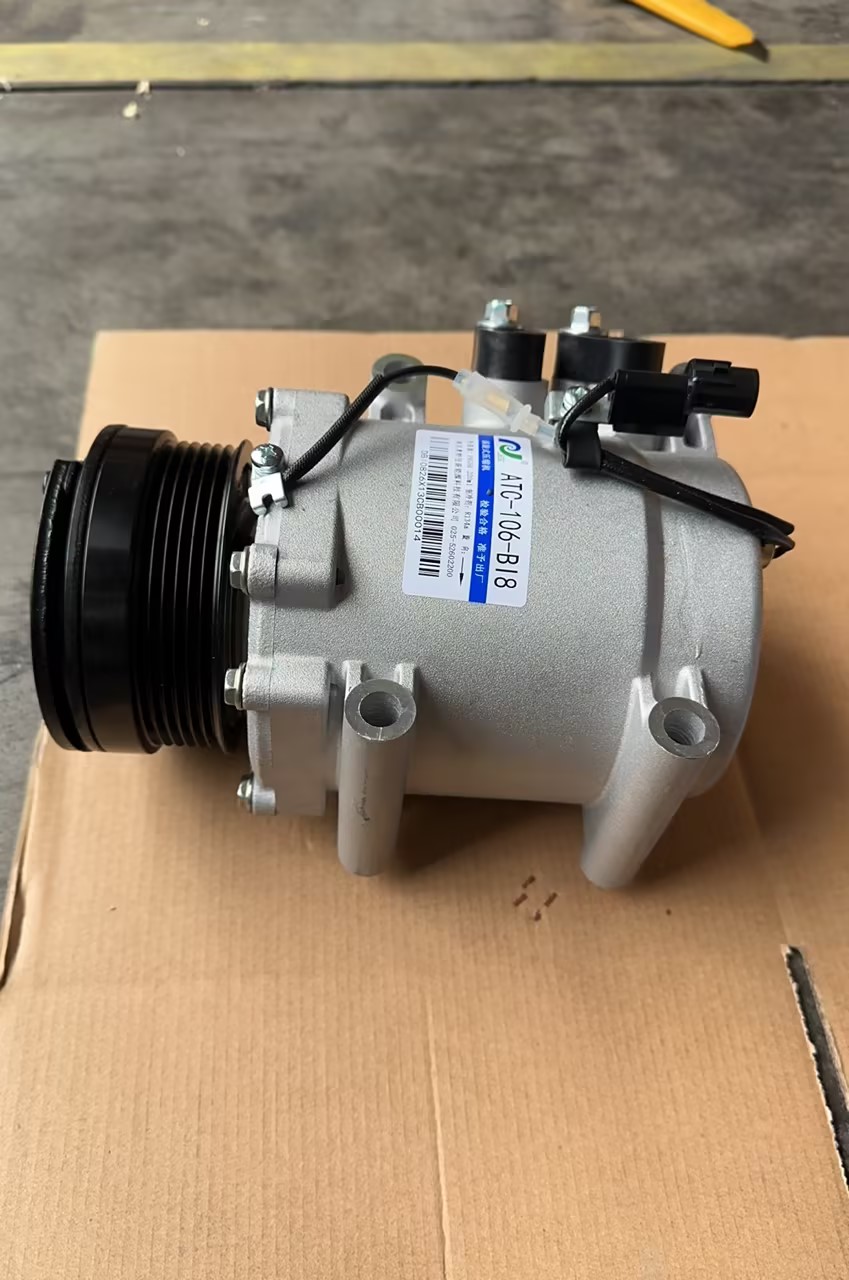
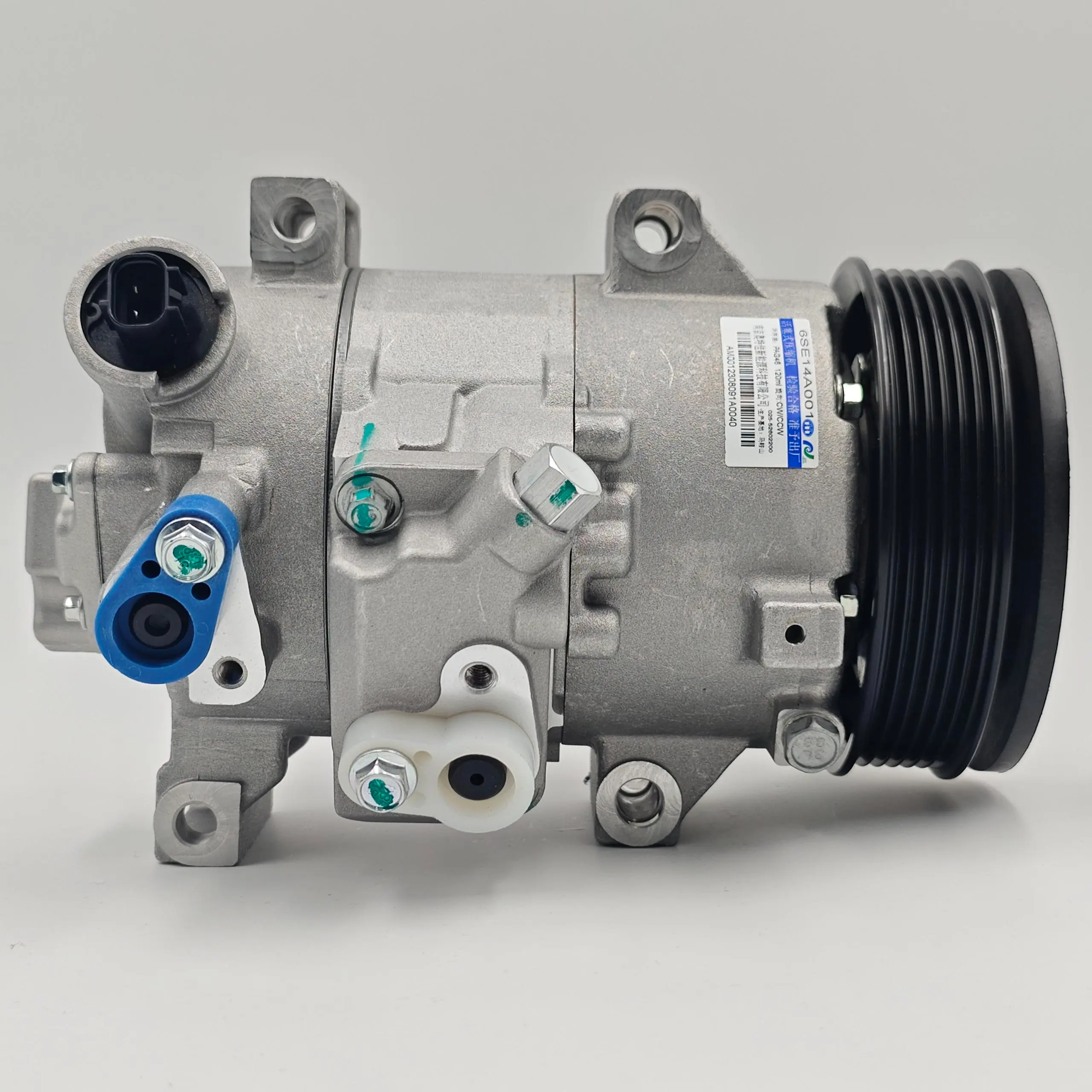
The automotive AC compressor is the core component of a vehicle’s air conditioning system. It is responsible for compressing and circulating refrigerant through the HVAC loop to remove heat from the cabin.
According to research in automotive thermal management and SAE climate control engineering studies, the compressor first increases the pressure and temperature of the refrigerant before directing it towards the condenser. This enables continuous heat exchange and cooling of the cabin throughout the refrigeration cycle.
Modern compressor technologies, including variable displacement, electric, rotary, scroll, and piston compressors, have significantly improved the energy efficiency, thermal comfort, and environmental performance of both internal combustion and electric vehicles.
Introduction: Why the Automotive AC Compressor Is So Important
Modern vehicles are no longer judged solely on engine performance, fuel economy, or exterior styling. Today, cabin comfort is one of the most important factors influencing consumer satisfaction, particularly in regions experiencing extreme summer temperatures, high humidity, or long commutes. As vehicle technology evolves towards electrification and intelligent climate management and energy optimisation, automotive air conditioning systems have become increasingly sophisticated and essential.
At the heart of every automotive HVAC system is one critical component:
The automotive AC compressor.
Without the compressor, the entire refrigeration cycle stops functioning. The compressor is responsible for:
- Compressing refrigerant gas
- Maintaining refrigerant circulation
- Creating pressure differences
- Enabling heat transfer
- Supporting cabin cooling efficiency
In practical terms, the compressor acts as the ‘heart’ of the automotive air conditioning system.
The increasing importance of thermal management is driven by several global trends:
- Rising global temperatures
- Electric vehicle growth
- Passenger comfort expectations
- Autonomous vehicle development
- Fuel efficiency regulations
- Environmental refrigerant regulations
Modern AC systems must now balance:
- Cooling performance
- Energy efficiency
- Low noise
- Reduced emissions
- Compact packaging
- Longterm durability
As a result, compressor technology has evolved dramatically over the past two decades.
Traditional fixed-displacement compressors have gradually been supplemented or replaced by the following:
- Variable displacement compressors
- Scroll compressors
- Rotary vane compressors
- Electric compressors
- High-voltage EV compressor systems
These technologies improve the following:
- Thermal efficiency
- Fuel economy
- Compressor lifespan
- Cabin comfort stability
At the same time, modern vehicles are increasingly using advanced electronic control systems to dynamically optimise compressor operation based on the following factors:
- Cabin temperature
- Ambient conditions
- Engine load
- Battery condition
- Occupant preferences
Understanding how an automotive AC compressor works is therefore valuable for:
- Automotive engineers;
- HVAC technicians;
- OEM procurement teams;
- Automotive parts distributors;
- Car owners;
- EV manufacturers;
- Fleet managers;
- Automotive students;
- Repair professionals.
This article provides a comprehensive industry-level explanation of:
- Car owners
- EV manufacturers
- Fleet managers
- Automotive students
- Repair professionals
This article provides a comprehensive, industry-level explanation of:
- The working principles of automotive AC compressors
- The refrigeration cycle
- The major types of compressors
- Failure mechanisms
- EV compressor technologies
- Maintenance strategies
- Energy efficiency improvements
- Future thermal management trends
While helping readers to understand why compressor technology remains fundamental to modern automotive climate control systems.
- Automotive AC compressor working principles
- Refrigeration cycle operation
- Major compressor types
- Failure mechanisms
- EV compressor technologies
- Maintenance strategies
- Energy efficiency improvements
- Future thermal management trends
It also helps readers to understand why compressor technology remains fundamental to modern automotive climate control systems.
What Is an Automotive AC Compressor?
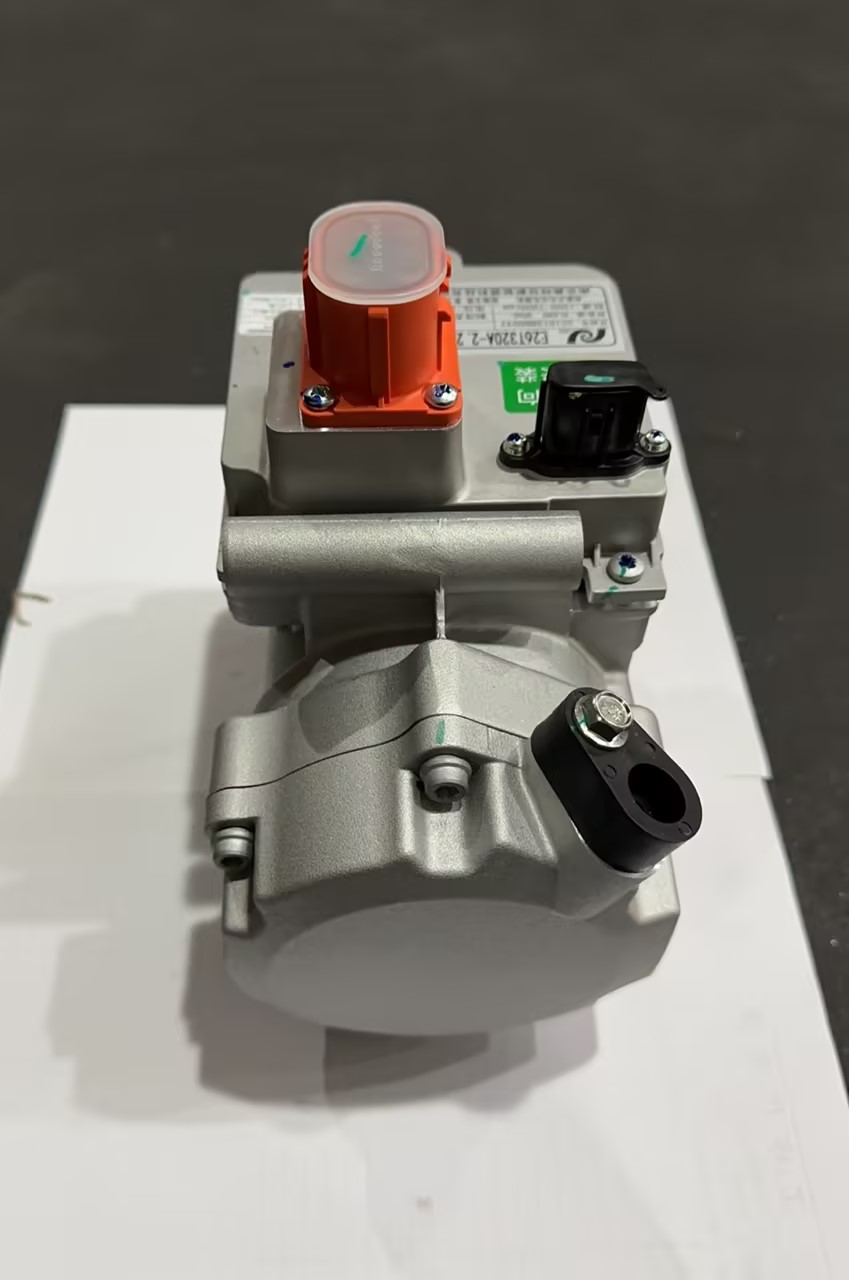
An automotive air conditioning (AC) compressor is a mechanical or electrically driven device that compresses and circulates refrigerant gas throughout the air conditioning system of a vehicle.
Its main functions include:
- Raising refrigerant pressure;
- Increasing refrigerant temperature;
- Driving refrigerant flow;
- Supporting heat exchange.
The compressor enables the refrigerant to continuously cycle through:
Compressor > Condenser > Expansion valve > Evaporator.
This closed-loop refrigeration cycle removes heat from the passenger cabin.
Without compression, the refrigerant cannot circulate properly or transfer heat effectively.
Basic Principle of Automotive Air Conditioning
Automotive air conditioning systems work using the principle of vapour-compression refrigeration.
The system does not ‘create cold air’.
Instead, it:
- Removes heat from the cabin
- Transfers that heat outside the vehicle
This process relies on refrigerant phase changes between:
gas and liquid.
The compressor initiates and sustains this thermodynamic cycle.
The Automotive Refrigeration Cycle Explained
Understanding the refrigeration cycle is essential to understanding compressor operation.
Main Refrigeration Stages
| Stage | Function |
| Compression | Raises refrigerant pressure |
| Condensation | Releases heat |
| Expansion | Reduces pressure |
| Evaporation | Absorbs cabin heat |
The compressor is the starting point of the cycle.
Step-by-Step: How Automotive AC Compressors Work
Step 1: Low-pressure refrigerant enters the compressor.
The refrigerant enters the compressor in the form of:
- lowpressure gas
- low-temperature vapour
This refrigerant comes from the evaporator after absorbing cabin heat.
Step 2: The compression process begins inside the compressor.
Mechanical components reduce the gas volume, causing pressure to increase rapidly and the refrigerant temperature to rise significantly. The compression process follows thermodynamic gas laws.
The higher pressure enables the refrigerant to reject heat inside the condenser.
Step 3: High-pressure refrigerant exits the compressor.
After compression:
- The refrigerant becomes a hot, high-pressure gas.
- The gas flows towards the condenser.
- The condenser releases heat to the outside air.
Step 4: Refrigerant cools and condenses inside the condenser. Heat is transferred to the ambient air, and the refrigerant changes from a gas to a liquid. This stage removes the heat that was extracted from the cabin.
Step 5: The expansion valve lowers the pressure
The liquid refrigerant then passes through:
- The expansion valve or orifice tube is causing a dramatic pressure drop.
- The temperature also decreases sharply.
Step 6: The evaporator absorbs cabin heat.
Inside the evaporator:
- Refrigerant evaporates again
- Cabin heat transfers into the refrigerant
- Cool air enters the passenger compartment
The cycle then repeats continuously.
Thermodynamic Principle Behind Compression
The compressor relies heavily on the physics of gas compression.
As gas pressure increases:
- Molecular energy increases;
- Temperature rises;
- Heat-carrying capability improves.
This relationship is central to refrigeration engineering.
The pressure-temperature relationship can be represented by the ideal gas law, and this thermodynamic behaviour enables efficient heat transfer throughout the HVAC cycle.
Main Components Inside an Automotive AC Compressor
Although designs vary, most compressors include the following components:
- A compression chamber;
- Pistons or scroll elements;
- Bearings;
- Shafts;
- A clutch or motor;
- A lubrication system;
- Seals.
Internal lubrication is especially important because compressors operate under:
- High pressure
- High rotational speeds
- Significant thermal loads
Types of Automotive AC Compressors
Several compressor technologies are widely used across modern vehicles.
Major Compressor Types
| Tipo di compressore | Common Applications |
| Piston compressor | Traditional vehicles |
| Rotary vane compressor | Compact systems |
| Scroll compressor | Modern passenger vehicles |
| Variable displacement compressor | Fuel-efficient vehicles |
| Electric compressor | EVs and hybrids |
Each technology offers different advantages.
Compressori a pistone
Piston compressors are one of the oldest designs of automotive air conditioning (AC) compressors.
They operate in a similar way to combustion engines:
- Pistons move inside cylinders
- Gas volume decreases
- Pressure rises
Advantages:
- Strong cooling capacity
- Durable construction
- Familiar servicing procedures
Disadvantages:
- Higher vibration
- More moving parts
- Lower efficiency than newer technologies
Compressori a spirale
Scroll compressors have become increasingly popular in modern vehicles.
They use:
- Two spiral scrolls, one stationary and one orbiting;
- As the refrigerant moves inward, the volume decreases, and the pressure increases smoothly.
- Volume decreases
- Pressure increases smoothly
Scroll compressor advantages:
- Lower noise
- Higher efficiency
- Reduced vibration
- Better reliability
These compressors are now widely used in:
- Passenger vehicles
- Hybrid vehicles
- Premium automotive HVAC systems
Rotary Vane Compressors
Rotary vane compressors use rotating vanes that are mounted inside a rotor assembly.
Benefits:
- Compact size
- Smooth operation
- Lightweight structure
Limitations:
- Wear sensitivity
- Lubrication dependency
They are commonly used in smaller automotive HVAC systems.
Variable Displacement Compressors
Modern fuel efficiency regulations have led to the increased adoption of:
Variable displacement compressors.
Unlike fixed compressors, these systems dynamically adjust the following:
- Refrigerant flow
- Compression volume
- Cooling output
Based on cabin demand.
Advantages:
- Improved fuel economy
- Reduced engine load
- Better temperature stability
Variable displacement technology greatly improves the overall efficiency of HVAC systems.
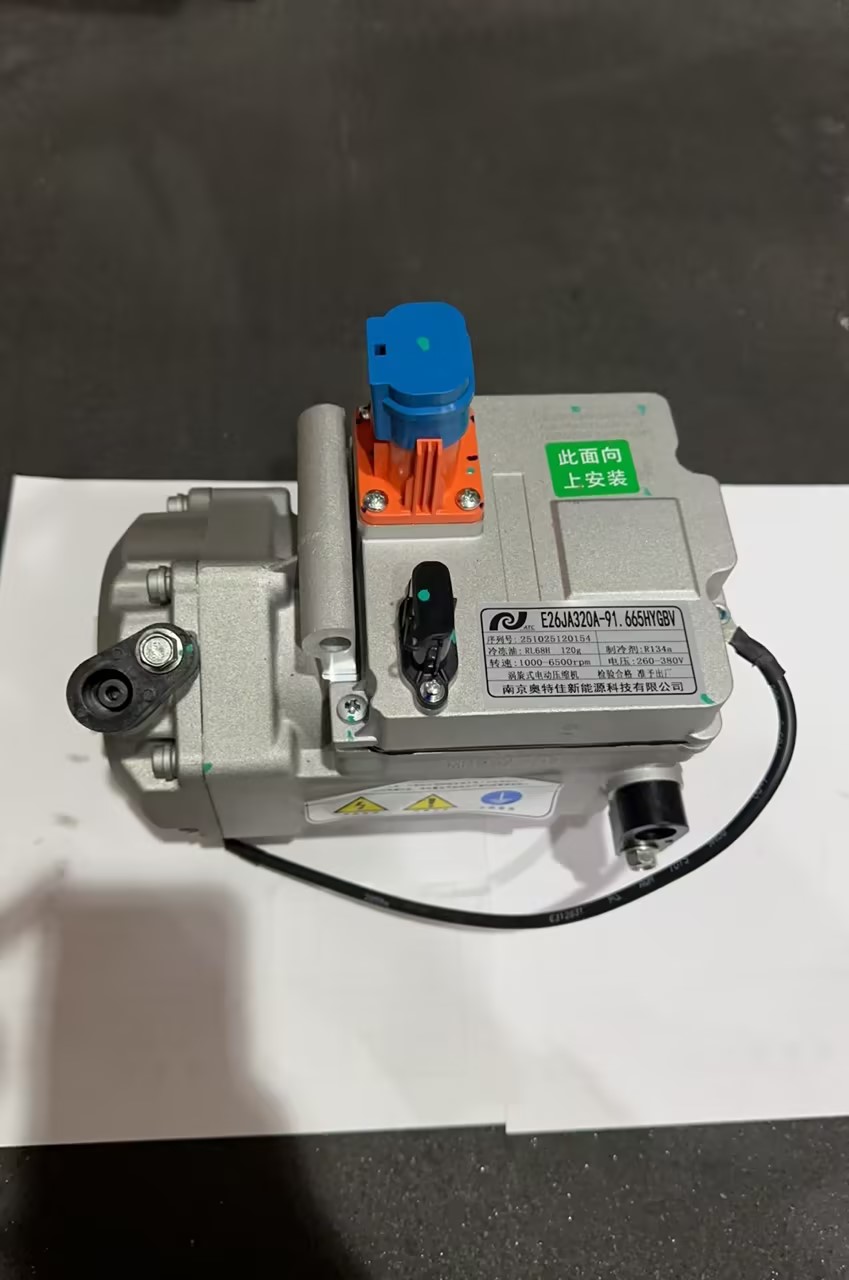
Electric Automotive AC Compressors
Electric compressors are transforming the industry.
Unlike traditional belt-driven compressors, electric compressors use:
- High-voltage electric motors;
- Independent electronic control.
These systems are essential for:
- Electric and hybrid vehicles
- Engine stop-start systems
Because cooling must continue even when engines are not running.
Why Do EVs Depend on Electric Compressors?
Electric vehicles require advanced thermal management for the following reasons:
- Cabin cooling affects battery range.
- Batteries require temperature regulation.
- There is no engine belt system.
Modern EV compressors therefore serve the following purposes:
- Cabin climate control
- Gestione termica della batteria
- Power electronics cooling
This dual-purpose role makes compressor efficiency even more critical.
Compressor Clutch Systems
Traditional compressors often use electromagnetic clutches.
The clutch engages compressor operation and disconnects the compressor when cooling is unnecessary, which reduces:
- Fuel consumption
- Mechanical wear
However, many modern systems now use continuously operating variable compressors instead.
Automotive Refrigerants and Compressor Compatibility
Different refrigerants require compatible compressor designs.
Common Refrigerants
| Refrigerant | Modern Usage |
| R134a | Older vehicles |
| R1234yf | Modern low-GWP vehicles |
| CO₂ (R744) | Emerging EV systems |
Refrigerant choice affects:
- Compressor lubrication
- Pressure levels
- Seal materials
- System design
Lubrication Inside Automotive AC Compressors
Compressor lubrication is essential for the following reasons:
- Components rotate at high speeds;
- Friction generates heat;
- Metal surfaces require protection;
- Special refrigeration oils circulate with the refrigerant through the HVAC loop.
Improper lubrication may cause:
- Bearing failure
- Internal scoring
- Compressor seizure
Common Automotive AC Compressor Failures
Compressors may fail due to:
- Refrigerant leaks
- Oil starvation
- Contamination
- Excessive heat
- Clutch failure
- Electrical faults
Poor maintenance significantly accelerates compressor wear.
Symptoms of a Bad Automotive AC Compressor
Common warning signs:
- Weak cooling
- Loud noises
- Clutch failure
- Refrigerant leakage
- Compressor seizure
- Cabin temperature instability
Early diagnosis can help prevent systemwide HVAC damage.
Why Can Compressor Failure Damage the Entire AC System?
Internal compressor failure may release the following contaminants:
- Metal debris
- Contaminants
- Burnt oil particles
These contaminants can spread throughout the following components:
- Condenser
- Expansion valve
- Evaporatore
- Refrigerant lines
Complete system flushing is often required after major compressor failure.
Automotive AC Compressor Maintenance
Proper maintenance can dramatically extend the lifespan of a compressor.
Best maintenance practices:
- Regular refrigerant inspection
- Leak detection
- Correct oil levels
- Condenser cleaning
- Belt inspection
- Cabin filter replacement
Routine servicing reduces the need for major repairs.
FAQ: Automotive AC Compressors
What does an Automotive AC Compressor do?
It compresses refrigerant gas and circulates it through the vehicle air conditioning system.
How does a car AC compressor create cold air?
It does not directly create cold air. Instead, it enables heat transfer through the refrigeration cycle.
What causes automotive AC compressors to fail?
Common causes include refrigerant leaks, oil starvation, contamination, overheating, and clutch problems.
Can a car run with a bad AC compressor?
Yes, but cooling performance will suffer, and severe compressor damage may affect other HVAC components.
How long does an Automotive AC Compressor last?
Many compressors last 8–15 years depending on maintenance and operating conditions.
What is the difference between fixed and variable displacement compressors?
Variable displacement compressors adjust cooling capacity dynamically, improving fuel efficiency and comfort.
Why do EVs use electric AC compressors?
Electric vehicles lack engine-driven belt systems, so electrically powered compressors are necessary.
Which compressor type is best for modern vehicles?
Scroll and variable displacement compressors are often preferred for efficiency, reliability, and low noise.
Conclusion
The automotive air conditioning (AC) compressor is one of the most important components in modern vehicle climate control systems because it enables the refrigeration cycle that is responsible for passenger comfort and thermal management. By compressing the refrigerant and maintaining pressure differentials throughout the HVAC system, the compressor enables heat to be efficiently removed from the cabin and transferred outside the vehicle.
As automotive technology evolves towards:
- Electrification
- Smart climate systems
- Energy optimisation
- Sustainable refrigerants
- Autonomous mobility
Compressor technology is also advancing rapidly.
Modern innovations include:
- Scroll compressors
- Variable displacement systems
- Electric compressors
- AI-assisted HVAC controls
have dramatically improved:
- Cooling performance
- Fuel efficiency
- Cabin comfort
- EV thermal management
At the same time, growing environmental regulations and rising consumer expectations continue to push manufacturers towards quieter, more compact, and more energy-efficient compressor systems.
Whether used in traditional petrol vehicles, hybrids, or next-generation electric platforms, the automotive AC compressor will remain central to automotive thermal management for decades to come.